How do you read pending sales before they close?
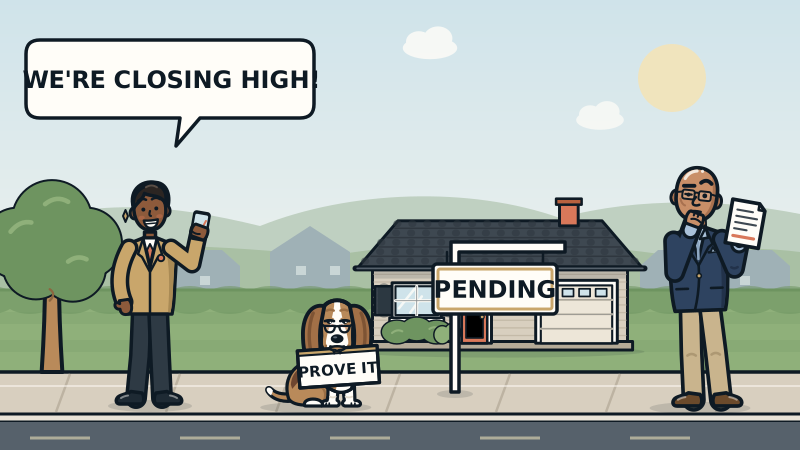
Estimate a pending sale's predicted close: its list price times the sale-to-list ratio measured on recent similar sales. Use a lower ratio, also measured, for listings that sat past about 40 days on market. Treat a price someone reports before closing as a lead to verify, not as evidence, until a record confirms it.
Pendings are the market talking right now
A closed sale tells you what a buyer agreed to a month or two ago. A pending sale tells you what a buyer agreed to last week. If you want to know where the market is today, pendings are the freshest evidence you can get your hands on.
Appraisers are told to look at them. Fannie Mae's Selling Guide says the appraiser must analyze closed sales, contract sales and current listings of the properties most comparable to the subject, and that doing so gives a more accurate picture of market conditions. Closed sales still carry the grid: the guide requires at least three, with contracts and listings used as supporting data.
The catch is that a pending has no confirmed price yet. You can see what the seller asked. You usually cannot see what the buyer agreed to pay. So the job is to estimate the price without pretending you know it. My other post covers how appraisers use pendings and listings on a grid. This one is about reading them before they close.
The predicted close: list price times a measured ratio
Here is the method I use. It fits on a napkin, which is good, because that is where most pricing conversations happen anyway.
- Build a panel of recent closed sales that are similar to the pending: same area, same kind of house, same price range.
- Measure the sale-to-list ratio for each one: sale price divided by the list price at the time it went under contract.
- Take the middle ratio and note how many sales it came from.
- Multiply the pending's list price by that ratio. That is the predicted close.
Say, hypothetically, 12 similar homes closed in the last 60 days, and the middle ratio was 99%. A pending listed at $1,150,000 points to a predicted close of about $1,138,500. Not $1,150,000, and not whatever the listing agent's smile suggested at the open house.
Always state the sample count. A ratio from 12 sales is evidence. A ratio from two sales is a rumor with a decimal point.
Listings that sat need their own ratio
One ratio does not fit every pending. A house that went under contract on day six and a house that went under contract on day 70 did not have the same negotiation.
Public research points the same way. Zillow Research found in 2016 that homes that sold almost immediately went for about 1% below list, while homes listed the longest, about eleven months on average, sold about 12% below list. Zillow said it did not test for cause. It is still a pattern worth testing in your own market.
So I measure an aged ratio. In my work, the line I use is about 40 days on market, and I check it rather than assume it: do the sales that went pending past that mark actually close at a lower ratio in this market? If they do, aged pendings get the aged ratio.
Back to the hypothetical. Say the fast sales closed at 99% of list and the ones past 40 days closed at 95%. A second pending, listed at $1,180,000 after sitting 52 days, predicts about $1,121,000. The house with the higher asking price predicts the lower sale. That happens more often than sellers like to hear.
Why "we're closing at" is not evidence yet
Every agent has heard it: "Ours is pending, and we're closing way over." Maybe it is true. Until it is verified, it is a story.
Fannie Mae's guide is careful here. Sales data can come from a party with a financial interest in the deal, but the appraiser must verify it with a party who does not have a financial interest in the subject transaction. The guide also says there has to be enough information to understand the conditions of sale and any financing concessions.
That second part matters. A reported price can hide a seller credit, a repair credit or a rate buydown. Credits are not worth dollar for dollar either. The adjustment is whatever the market actually reacted with, and that has to be measured. And a pending can still fall out of escrow, which no rumor ever mentions.
So I default to the evidence-backed predicted close. When the sale closes and the price can be confirmed against a record, the confirmed price replaces the prediction. Until then, the predicted close stands, and the report says how it was built.
How to use pendings when you price or defend a listing
- List every pending that competes with your house, with list price, days on market and any price cuts.
- Measure two ratios from recent closed sales: one for homes that went pending fast and one for homes that sat. Note the count behind each.
- Price each pending at its predicted close, using the ratio that matches its days on market.
- Separate the fast from the stale. Three pendings that went under contract in a weekend tell a different story than three that went under contract after two price cuts.
- Send what you can verify. If you know a pending's terms or credits and are allowed to share them, send them to the appraiser through the lender, with the source. A verifiable fact helps. A secondhand number does not.
- Update when it closes. Once a pending records, the real price replaces the prediction. Recheck your ratios too, because every new closing makes the panel better.
What I see in the field
In a turning market, pendings are often where I see the change first. Closed sales lag because their contracts were written weeks ago. The pendings show buyers' current mood, whether that mood is a bidding frenzy or a parade of polite second showings.
I pride myself in adjusting in real time, and pendings are a big part of how I do it. I carry the market trend to the effective date with the live pendings at their predicted close instead of holding it flat at the last closed sale. That way the report describes the market on the day it is dated, not the market as it looked when the last escrow opened.
Read them with discipline, though. A pending is a promise. A closed sale is a fact. The predicted close is how you use the promise without mistaking it for the fact.
Key takeaways
- Predicted close equals list price times the sale-to-list ratio measured on recent similar sales.
- Use a separate, lower ratio for listings that sat past about 40 days, and confirm the market really prices them lower.
- State the number of sales behind every ratio.
- A price someone reports before closing is a lead to verify, not evidence.
- When the sale records, the confirmed price replaces the prediction.
Get the best posts once a week.
Priced Right is one email a week with the most useful appraisal and pricing posts and what the market is doing. Never more than one a week. Unsubscribe anytime.
People also ask
Can an appraiser use a pending sale as a comparable?
Yes, as supporting data. For loans sold to Fannie Mae, at least three closed sales are still required, with pendings and listings added to show where the market is heading. Other loan programs and private assignments set their own rules.
Should I use the original list price or the current one?
Measure the ratio the same way you apply it. If your ratios use the list price at the time each sale went under contract, apply them to the pending's list price at contract, and note any price cuts separately.
Why use the middle ratio instead of the average?
The middle ratio, or median, is not pulled around by one odd sale, like a bidding war or a distressed sale. With a small panel, that matters.
Sources
Got a question we haven't answered?
Suggest a topic or ask your own appraisal question. The best ones become posts.