SB 9 lot split: what is the new lot actually worth?
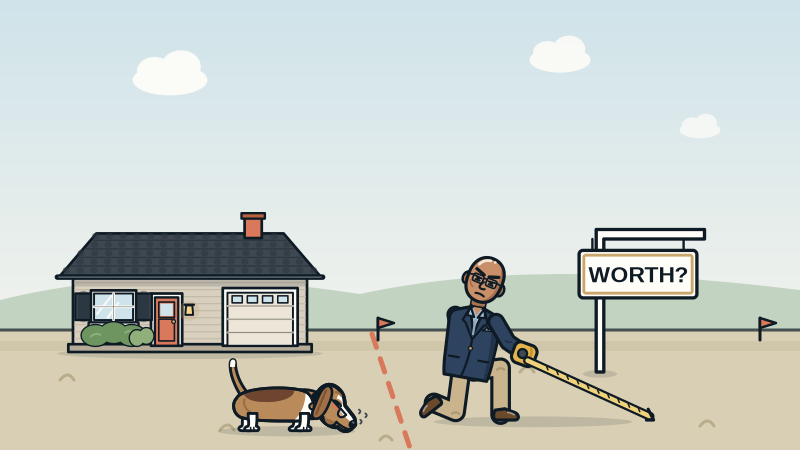
A new SB 9 lot is worth what buyers actually pay for similar buildable lots nearby, minus the cost, time and risk of making yours buildable: utilities, an access easement, the parcel map and permits. The house you keep is now on a smaller lot, so check that the two pieces together beat the one you started with.
What SB 9 actually lets you do
SB 9 is the California law that lets an owner split one single-family lot into two and build up to two homes on each. The lot split part lives in Government Code section 66411.7. The two-homes-per-lot part lives in section 65852.21.
The basic rules for an urban lot split:
- Two lots, close to equal. Neither new lot can be smaller than 40 percent of the original lot.
- At least 1,200 square feet each, unless your city adopted an ordinance allowing smaller.
- Single-family zone in an area the Census Bureau counts as urban.
- Staff approval, not a hearing. The city checks the map against objective written standards. A 2024 law, SB 450, says the city must approve or deny a complete application within 60 days, or it is deemed approved.
- Limits on what the city can demand. Side and rear setbacks of up to four feet, no more than one parking space per unit (none near major transit or car share), and no forced street dedications or offsite improvements.
That sounds like free money. Your backyard just became a second property, and all it took was a survey and some patience. Hold that thought. Free money is the most expensive kind.
The fine print that shapes who will buy
Value comes from buyers, and SB 9 has rules that decide which buyers can play.
- The owner affidavit. The person applying for the split must sign an affidavit saying they intend to live in one of the units as their principal residence for at least three years from approval. Community land trusts and qualified nonprofits are exempt. A pure investor who never plans to move in is not the intended applicant.
- One split per lot, ever. A lot created by an SB 9 split cannot be split again, and an owner cannot split two neighboring lots they or a partner own.
- Two units means two. The city does not have to allow more than two units on a new lot, and ADUs and junior ADUs count toward that two.
- No short stays. Units built this way must be rented for terms longer than 30 days.
- Some lots are out. The law does not apply where the work would demolish or alter rent-controlled or deed-restricted housing, housing a tenant lived in within the last three years, or units pulled off the rental market under the Ellis Act within 15 years. Certain protected and hazard lands are excluded too. A 2025 law, AB 1061, rewrote the historic district rules starting January 1, 2026.
Every one of these rules is a reason a buyer might pay less, or pass. The vacation rental crowd, for one, just left the open house.
What the new lot is worth
A vacant lot is worth what buyers of similar buildable lots actually pay. Not what a builder said at a barbecue. Not the price per square foot of your house divided by something.
Here is how I build the number:
- Find lot sales. Recent sales of vacant, buildable lots of similar size and zoning, as close to the subject as the data allows. In built-out neighborhoods there may be few, so I widen the search and say so.
- Match what was sold. A lot that sold with water, sewer and power at the street, a recorded map and permits in hand is a different product from one that still needs all three.
- Subtract what your lot still needs. New utility connections, a driveway or access easement along the side of the house, the survey and parcel map, plan and permit fees, and the months it takes.
- Price the risk. Buyers pay less for a lot whose approval, utilities or access are still a question. That discount has to show up in real sales, not in my imagination.
A flag lot, the kind reached by a long driveway past the front house, often trades differently from a lot with its own street frontage. Whether it does in your market is a question for the sales, so I measure it with paired sales: two lots alike except for the one feature, and the price difference between them.
Two pieces are not always worth more than one
This is the part people skip. When you split the lot, the house you keep changes too. It may lose its big yard, its side driveway, its garage access or its privacy, and it now has a neighbor 4 feet off the back line.
So the real test is before and after. Here is a hypothetical with made-up round numbers, only to show the math:
| Item | Hypothetical value |
|---|---|
| House on the full lot, before the split | $1,500,000 |
| Same house on the smaller lot, after | $1,300,000 |
| New lot, ready to build | $320,000 |
| Map, utilities, access, permits and time | minus $160,000 |
| Net after the split | $1,460,000 |
In this made-up case the owner spent a year and a lot of money to end up $40,000 behind. Change the lot price or the costs and the answer flips. That is the point: you find out with your market's sales, not a hunch.
Appraisers call this highest and best use. In plain words: of the uses that are legal, physically possible and pay for themselves, which one makes the property worth the most? Sometimes that is two lots. Sometimes it is one house with a really nice yard.
What I see in the field
The most common mistake is pricing the new lot off the best lot sale in town and ignoring what it took to get that lot there. The second is forgetting that the front house just got smaller in every way except square footage.
I also see owners assume their lender will cheer. Your mortgage is secured by the whole lot. Splitting it changes the lender's collateral, so call your lender before you file, not after the map is drawn.
And I see uncles. Every family has one who says the backyard is "easily worth half a million." Uncles are wonderful at Thanksgiving. They are not comparable sales.
For an owner on the fence, I value the property as it sits, the house on its smaller lot, and the new lot as it would sell. That before-and-after comparison is the kind of work I do in a private appraisal or consultation. If you are weighing an ADU instead, the same logic applies, and California's ADU condo law is its own story in this post on AB 1033.
What to do before you file
- Call your city's planning department. Ask for its SB 9 ordinance, its objective standards and any minimum lot size below 1,200 square feet. Local rules vary.
- Confirm your lot qualifies. Zoning, tenant history in the last three years, rent control, historic status and hazard maps.
- Get utility answers in writing. Where water, sewer and power would come from, and the cost.
- Sketch the access. If the new lot needs a driveway past your house, see what it takes from the house you keep.
- Talk to your lender about what a split does to your loan.
- Get a before-and-after valuation from real lot and home sales, so you know whether the split adds money or just adds work.
- Ask a California real estate attorney and your CPA about the affidavit, title and taxes before you sign anything.
Key takeaways
- SB 9 can create a second lot, but a lot is only worth what buyers of similar buildable lots pay.
- Subtract utilities, access, the parcel map, permits, time and risk before you count the money.
- The house you keep usually loses yard, access or privacy, so value it again on the smaller lot.
- The owner affidavit, the two-unit cap and the 30-day rental rule all shape who will buy.
- Run the before-and-after math with real sales. Sometimes one lot is worth more than two.
Get the best posts once a week.
Priced Right is one email a week with the most useful appraisal and pricing posts and what the market is doing. Never more than one a week. Unsubscribe anytime.
People also ask
Do I have to live on the property after an SB 9 lot split?
The person applying for the split must sign an affidavit stating they intend to live in one of the units as their principal residence for at least three years from approval. Community land trusts and qualified nonprofits are exempt. Ask an attorney how this applies to your situation.
How many homes can I build after an SB 9 split?
Up to two units on each new lot, so up to four in total. On a lot created by an SB 9 split, the city does not have to allow more than two units, and ADUs and junior ADUs count toward that limit.
Can an appraiser value my lot before the split is approved?
Yes. An appraiser can value the property as it is today and give a hypothetical value as if the split were approved, as long as the report clearly states that assumption. The as-is value and the after-split values answer different questions.
Sources
Got a question we haven't answered?
Suggest a topic or ask your own appraisal question. The best ones become posts.