Can I legalize an unpermitted ADU in California, and is it worth it?
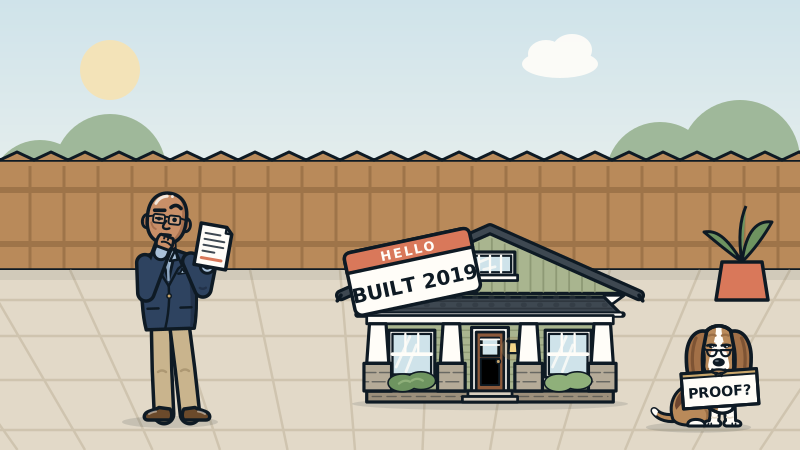
Often, yes. Under California's AB 2533 (Government Code section 66332), a city or county generally cannot deny a permit to legalize an ADU or junior ADU built before January 1, 2020 over building code problems, unless fixing them is needed for health and safety. Whether legal status pays off depends on local sales.
What California's ADU amnesty rules actually say
"Amnesty" is the word people use. The law is more specific than that, and it comes in two pieces.
The legalization rule. AB 2533, signed September 28, 2024, amended Government Code section 66332. For an unpermitted ADU or junior ADU (a JADU, a small unit carved out of the main house) built before January 1, 2020, a local agency generally cannot deny a permit to legalize it because of building code violations, unless it finds that correcting the violation is needed to protect health and safety. City pages describing the law, like Oakland's, add that the city cannot penalize an owner for having the unit when the owner applies for and gets the permits to fix health and safety problems.
The enforcement delay. SB 13, from 2019, lets an owner of a qualifying pre-2020 ADU ask the local enforcement agency to delay enforcing building standards for five years, so the owner has time to fix the problems. It does not apply when the violation is a health and safety issue. That rule lives in Health and Safety Code section 17980.12 and Government Code section 66331.
One housekeeping note. In 2024, SB 477 moved California's ADU statutes, including old sections 65852.2 and 65852.23, into a new chapter starting at section 66310. If you see the old numbers on a city handout, it is the same law in a new apartment.
Amnesty does not mean free, and it does not mean skip the inspection
The state law takes away the easy "no." It does not take away the inspection. Expect the city to look at the unit and require fixes for anything that makes it unsafe to live in, such as wiring, smoke alarms, exits, heat or sewer issues.
Each city builds its own process on top of the state rule. A few real examples:
- Oakland uses an AB 2533 application and checklist, an affidavit about when the unit was built, and dimensioned site and floor plans. It also lets owners ask to have plans reviewed under the current code or the code in effect when the unit was built.
- Anaheim asks for sewer capacity confirmation and a property evaluation permit to find health and safety issues before it grants a delay, and suggests an optional inspection by a licensed contractor first.
- Berkeley, Napa County and Permit Sonoma publish their own enforcement delay request forms.
Fees vary too. Oakland's page says owners generally do not pay impact fees or connection and capacity charges for a qualifying unit, with an exception where utility work is needed for health and safety. Ask your building department for its current fee list before you assume anything. The only universal cost is the one nobody puts on a fee schedule: your Saturdays.
How lenders and appraisers treat an unpermitted unit
Permits and zoning are two different questions, and the appraisal has to answer both.
On permits, Fannie Mae's Selling Guide says that when an appraiser finds an addition without a required permit, the appraiser must comment on the quality and appearance of the work and its effect, if any, on market value. I cover how that plays out in how appraisers handle unpermitted additions.
On the unit itself, Fannie Mae counts an ADU as a separate living area with its own living, sleeping, cooking and bathroom facilities, on the same parcel as a one-unit home. Only one ADU is allowed for a Fannie Mae loan, and none with a two to four unit property. The ADU goes on its own line in the grid. It is never added to the main house's square footage, a rule I explain in does an ADU count in square footage.
If an ADU is not allowed under zoning at all, Fannie Mae still allows the loan when the lender confirms it will not jeopardize a future insurance claim, the appraisal states the use is not legal, and the report shows at least two comparable sales with the same non-compliant use, out of at least three closed sales. Finding two of those can be like finding two matching socks after a move. Other loan programs and portfolio lenders set their own rules, so ask early.
What legal status is worth is a market question
There is no state chart that says a permitted ADU adds X dollars. Anyone who quotes you one is quoting a feeling.
Here is what changes when a unit goes legal. More lenders can finance it with fewer conditions. Buyers stop worrying about a city letter showing up after closing. Insurance questions get easier. A legal rental is easier to show on paper. Whether buyers in your neighborhood pay more for those things, and how much, has to be measured.
The way to measure it is paired sales: similar homes, close in time and location, one with a permitted unit and one with an unpermitted unit. The price gap, after other differences are adjusted, is what buyers actually did. When those pairs are thin on your street, I go wider and further back, and adjust older sales to today. An older sale can still tell you something if it is adjusted to the market and to the house.
A hypothetical, so you can see the math. Say legalizing costs $40,000 in plans, permits and fixes. If paired sales in your area show legal units sell for about $25,000 more, legalizing for the sale alone loses money. If they show $70,000, it pays. Those numbers are made up for the example. Yours come from your market.
What to do before you file or list
- Pull your permit history from the building department. Sometimes part of the work was permitted and the county record never caught up.
- Gather proof of the build date. The pre-2020 cutoff matters, and cities like Oakland ask for an affidavit. Old photos, invoices and utility records help.
- Read your city's checklist before you open a permit, so you know the health and safety items it will look for.
- Get the fix list priced by a licensed contractor before you commit.
- Call a loan officer early if you are selling or refinancing, so you know which buyers can finance the unit as it is.
- Get a value read both ways. A pre-listing appraisal can show the value as is and the market's reaction to a legal unit, so you compare the gap to the cost.
- Talk to your agent and, if needed, an attorney about disclosure. A surprise late in escrow costs more than an honest line in the disclosures.
What I see in the field
The two most common mistakes run in opposite directions. One owner lists a converted garage as part of the house, adds its area to the square footage, and prices it like a bigger home. Another owner assumes the unit is worth zero and never asks what buyers would pay for it.
Neither one is measured. Unpermitted space is not automatically worthless, and a permit is not automatically a bonus. The market decides, and the sales show what it decided.
When I value a property with an unpermitted unit, I report what is there, note what the records show, and keep the unit off the main house's square footage. Then I look for sales that tell me how buyers in that area treat a unit like it. Facts over feelings, even when the feeling is a very cute studio with a mini fridge.
Key takeaways
- AB 2533 (Government Code 66332) limits when a city can deny a permit to legalize an ADU or JADU built before January 1, 2020.
- Health and safety problems still have to be fixed, and each city runs its own process.
- An owner may request a five-year enforcement delay under Health and Safety Code 17980.12 for issues that are not health and safety.
- An ADU is never added to the main house's square footage. It goes on its own line.
- Whether legalizing pays off depends on local paired sales, not a statewide number.
Getting this answered in California
Local agencies including the City of Oakland, the City of Anaheim, Permit Sonoma and Napa County publish their own legalization or enforcement delay programs for unpermitted ADUs, so the steps differ by city and county. I am a California Certified Residential Appraiser (License AR041465) and appraise homes statewide, including Alameda County, Orange County, Sonoma County, Napa County. See every area I serve.
Get the best posts once a week.
Priced Right is one email a week with the most useful appraisal and pricing posts and what the market is doing. Never more than one a week. Unsubscribe anytime.
People also ask
Can a California city deny a permit for my unpermitted ADU?
For an ADU or JADU built before January 1, 2020, a city generally cannot deny a legalization permit over building code violations unless it finds that fixing them is needed for health and safety. Units built after that date do not get this protection, so ask your building department how it handles them.
Does an unpermitted ADU lower home value in California?
It can, because fewer lenders and buyers are comfortable with it, but it is not automatically worth zero. The effect is measured by comparing sales of similar homes with permitted and unpermitted units in the same market.
What is the five-year ADU enforcement delay in California?
Under Health and Safety Code section 17980.12, the owner of a qualifying ADU built before 2020 can ask the local enforcement agency to delay enforcing building standards for five years to allow time for corrections. It does not cover health and safety violations, and each agency sets its own application steps.
Can I get a mortgage on a house with an unpermitted ADU?
Sometimes. Fannie Mae has a path for ADUs that zoning does not allow, with insurance and appraisal conditions, while other programs and portfolio lenders set their own rules. Talk to a loan officer before you list or refinance.
Sources
- City of Oakland: Legalize Your Unpermitted ADU or JADU (AB 2533)
- California HCD: ADU ordinance review letter to the City of Hayward (Gov. Code 66331, 66332; HSC 17980.12)
- City of Anaheim: ADU Delay of Enforcement Application (AB 2533 and SB 13)
- Fannie Mae Selling Guide B2-3-04: Special Property Eligibility Considerations
- Fannie Mae Selling Guide B4-1.3-05: Improvements Section of the Appraisal Report
Got a question we haven't answered?
Suggest a topic or ask your own appraisal question. The best ones become posts.