How is a California property with two houses on one lot appraised?
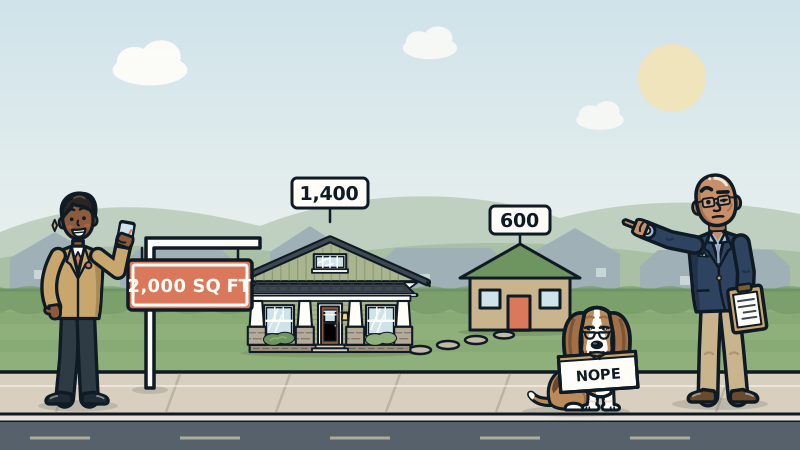
A California appraiser first decides whether two homes on one lot are a single-family home with an accessory dwelling unit (ADU) or a two-unit property, using Fannie Mae factors like separate meters, a separate address and whether the unit can be legally rented. The main home's square footage stands alone, and the second home is valued on its own line.
Two houses, one parcel, one big question first
You see them all over California's older neighborhoods: a front house on the street and a second little house in back, sometimes older than the owner's car collection, sometimes brand new. One lot. One tax bill. Two front doors.
Before I measure anything, I have to answer one question: what is this property, legally and in the market? There are two main answers.
- A one-unit home with an ADU. The front house is the primary home and the back house is an accessory dwelling unit, which Fannie Mae defines as living area independent of the main home with its own living, sleeping, cooking and bathroom facilities on the same parcel.
- A two-unit property. Two homes treated as a duplex, even if they do not touch.
Fannie Mae says the appraiser decides this from the property's characteristics, which may include separate utility meters, a unique postal address and whether the unit can be legally rented. That call is part of the highest and best use analysis, meaning the legal, possible and most valuable use of the property. It changes the loan, the comps and the math, so it comes first.
The main home's square footage never includes the back house
This is my rule, and Fannie Mae's too. A detached second home never counts in the main house's square footage. Fannie Mae says ADU living area should not be included in the primary home's finished above-grade area. It gets reported and adjusted on its own line.
So a 1,400 square foot front house with a 600 square foot back house is a 1,400 square foot house with a 600 square foot second home. It is not a 2,000 square foot house, no matter how the listing reads or how loudly the seller's cousin insists. Bedrooms and baths follow the same rule. If the only second bathroom is out back, the front house has one bathroom.
What if the back structure is missing pieces? Fannie Mae's kitchen standard for an ADU requires cabinets, a countertop, a sink with running water and a stove or a stove hookup. A hotplate or a microwave does not count. A finished back building that does not meet the ADU minimums is still worth something. It goes on its own line as an outbuilding and is adjusted for what it adds.
For more on measuring, see does an ADU count in square footage.
When it is a two-unit property instead
If the property works as two units, the whole approach changes. Fannie Mae allows only one ADU on a one-unit property, and it does not allow ADUs with a two- to four-unit dwelling. A front house, a back house and a converted garage apartment can push a property out of the one-unit box entirely.
A two-unit property gets compared to other small income properties, and for Fannie Mae loans the income approach is required on two- to four-unit properties. Buyers of these often think in price per unit and in rent, not price per square foot. The appraiser has to support market rent from comparable rentals, which may not match what the tenant out back pays today.
The loan changes too. Two-unit loans and one-unit-with-ADU loans can have different down payments, rules and forms. Loan officers, this is the conversation to have before the appraisal is ordered, not after it comes back with a surprise on page one. More on that side in how 2–4 unit properties are appraised.
Finding comps that match
The best comparable sales (comps) look like the subject: a main house plus a second home, in the same kind of setup. Those sales are thinner than ordinary sales. Fannie Mae allows an older closed sale to qualify as a comp when the property has an ADU, and active or pending listings can show up as extra support for how it markets. An older sale can still tell you something when it is adjusted to today's market and to the house.
Each comp needs the same treatment as the subject. If a sale's listing lumped both homes into one square footage figure, I split it back out before I use it. If the record only carries the combined number and nothing else separates them, that sale may not work for size at all.
Then I measure what the second home adds with real sales, ideally paired sales: two similar properties that differ mainly in having the back house, so the price gap shows what buyers paid for it. Rent helps too when the unit is rented. A rule of thumb like "a back house adds a third" is not evidence. It is a guess wearing a nice shirt.
Permits and California's ADU law
California's state ADU law now lives in Government Code sections 66310 to 66342, and the state housing department (HCD) publishes fact sheets on it. It has made backyard homes far easier to build. It also allows only one junior ADU per single-family lot, and certain ADU and junior ADU rentals must be for more than 30 days.
Many older second homes predate all of that. Permit history matters. A permitted second home, an older one the city recognizes and one zoning does not allow at all are valued and financed differently. For an ADU zoning does not allow under any circumstance, Fannie Mae requires the report to say so, and to include at least two comps with the same kind of noncompliant use and at least three closed sales in total.
Selling the back house on its own is a separate question. That only works where a city has opted in under AB 1033, covered in this post on selling an ADU separately.
What to do before the appraisal
- Gather permits for both homes, with final sign-off dates. Pull the city's record if you do not have them.
- List two sets of numbers: square footage, bedrooms and baths for the front house, and the same for the back house.
- Note what is separate: meters, addresses, entrances, parking and laundry.
- Bring leases and rent if either home is rented, plus how long it has been rented.
- Ask the loan officer whether the loan is being written as a one-unit with ADU or a two-unit property, and make sure the appraisal order matches.
- Arrange access to both homes and let any tenant know the date in writing.
If you are deciding how to list or refinance one of these, a private appraisal can show what the second home adds in your market. Questions about zoning or legal status go to the city planning department, and tax questions go to your CPA.
Key takeaways
- First question: is it a one-unit home with an ADU or a two-unit property?
- The back house never counts in the main home's square footage. It gets its own line.
- Fannie Mae allows one ADU on a one-unit property and none on a two- to four-unit property.
- Comps should match the setup, and the second home's value is measured from real sales and rents.
- Permits and zoning change how the property is valued and financed.
Getting this answered in California
California's ADU law applies statewide, so two homes on one lot can turn up in any county, including the dense older neighborhoods of Los Angeles, Alameda, San Francisco and Santa Clara counties. I am a California Certified Residential Appraiser (License AR041465) and appraise homes statewide, including Los Angeles County, Alameda County, San Francisco County, Santa Clara County. See every area I serve.
Get the best posts once a week.
Priced Right is one email a week with the most useful appraisal and pricing posts and what the market is doing. Never more than one a week. Unsubscribe anytime.
People also ask
Is a house with a separate back house a duplex in California?
Not automatically. The appraiser looks at things like separate meters, a separate address and whether the unit can legally be rented to decide if it is a one-unit home with an ADU or a two-unit property. Zoning and permits matter too.
Does a second house on my lot count toward my square footage?
No. Under Fannie Mae's rules and my own practice, a detached second home is never added to the main home's square footage. It is reported and valued on its own line.
Can I get a regular mortgage on a California lot with two houses?
Often yes, but the loan type depends on how the property is classified. Fannie Mae allows one ADU on a one-unit property, while a two-unit property is financed under two- to four-unit rules. Ask your loan officer before the appraisal is ordered.
How much value does a second house on the lot add in California?
There is no fixed amount. The appraiser measures it from local sales of similar properties with and without a second home, plus rent where the unit is rented, and the answer varies by neighborhood.
Sources
Got a question we haven't answered?
Suggest a topic or ask your own appraisal question. The best ones become posts.