Why did two appraisals on the same California house come in so different?
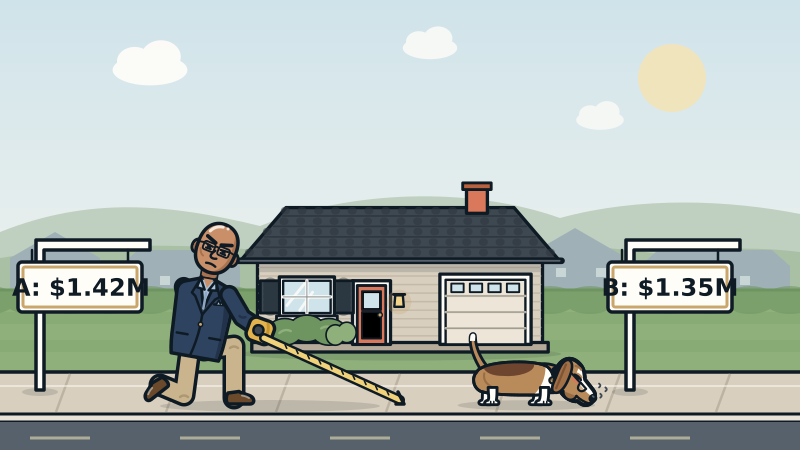
Two appraisals on the same California house can differ because of different effective dates, comparable sales, square footage, condition ratings, adjustments or scope, such as desktop versus full inspection. Line the reports up side by side to find the cause. Fannie Mae tells lenders to rely on the most reliable appraisal, not the highest value.
Two honest appraisals can still disagree
An appraisal is a licensed opinion of value, backed by evidence. Two appraisers can look at the same house and the same market and land in different places without either one doing anything wrong. Small gaps are normal. Value is a range, and each report has to pick one point in it.
Big gaps are different. When two reports on the same house are $60,000 or $100,000 apart, something specific is driving it. The good news is that the cause is almost always findable. The two reports are not two horoscopes. They are two sets of facts and math, and you can line them up side by side.
Before you decide which appraiser to send a strongly worded email, find out which of the reasons below explains the gap.
The seven usual reasons the numbers split
- Different effective dates. Every appraisal values the house as of one specific day. A report as of March and one as of August are measuring two different markets. A retrospective date-of-death value and a current value are two different questions.
- Different comps. One appraiser used the three sales on your street. The other reached across a busy boulevard into a pricier pocket.
- Different square footage. County records, old listings and actual measurements often disagree. Fannie Mae requires appraisers to measure to the ANSI Z765-2021 standard for appraisals with an interior and exterior inspection and for hybrids.
- Different condition ratings. One report calls the kitchen updated. The other calls it tired. Buyers react to condition more than age, so this line can carry real money.
- Different adjustments. One appraiser measured what buyers paid for a pool or an extra bath with local sales. The other used a rule of thumb.
- Different scope. A desktop with no site visit relies on records, photos and what the owner reports. A full inspection sees the sloping floor and the new roof firsthand.
- Different intended use or type of value. As-is versus as-completed, a lender report versus a private one for an estate, a divorce or pricing. Each answers its own question.
How to compare the two reports side by side
Pull up both reports and fill in this table. Often the gap explains itself before you reach the last row.
| Check | What to look for |
|---|---|
| Effective date | Same day? If not, did prices move between them? |
| Scope | Full inspection, exterior only or desktop |
| Square footage | Same number? Who measured, and how? |
| Beds, baths, lot | Same counts and the same lot size basis |
| Condition and quality | Same ratings? What facts back each one? |
| Comps | Any shared sales? Do the shared ones get the same adjustments? |
| Time adjustment | Did one report adjust for market change and the other not? |
| Adjustment support | Measured from local sales, or a flat rate with no backup? |
| Reconciliation | Does each report explain why its value lands where it does? |
Shared comps are the best clue. If both reports used the same sale and adjusted it differently, you have found the exact line where they part ways.
A hypothetical: one San Jose ranch, two answers
Say a hypothetical 1950s ranch in San Jose gets appraised twice. Report A, done for a refinance, says $1,420,000 as of March. Report B, done for a pre-listing price check, says $1,350,000 as of August.
Line them up and the story appears. Report A used 1,480 square feet from county records. Report B measured 1,390. Report A rated the house C3 based on a kitchen remodel. Report B noted that the remodel was 14 years old and the baths were original, and rated it C4. And between March and August, the local sale-to-list ratio slipped, so Report B's newer comps sold for less.
Now the gap is not a mystery. It is three specific questions: who measured correctly, which rating the facts support, and what the market did over five months. Each one can be checked. Nobody needs to light a candle or call the uncle who "knows the market."
Which one holds up, and what the rules say
The right report is the more credible one, not the higher one or the lower one. The one with the correct facts, the closest and most recent comps, adjustments measured from the market and a reconciliation that explains itself wins.
Lenders follow that idea too. Fannie Mae's Selling Guide tells lenders to keep a policy of selecting the most reliable appraisal rather than the one with the highest value, and to document why they relied on it. Federal Regulation Z also allows lenders to get multiple valuations to select the most reliable one. FHA has its own stricter rules on second appraisals, and some jumbo programs require two from the start.
If a report has a real error, the path is a reconsideration of value through your lender. Fannie Mae allows one borrower-initiated request per appraisal, so make it count with specific facts and better sales. More on that in whether you can get a second appraisal.
What I see in the field, and what to do next
When I do a desktop review, meaning a second opinion on another appraiser's report, the gap usually traces back to one or two lines: a square footage pulled from records nobody checked, or a condition rating that the photos do not back up. Rarely is it some deep mystery. It is usually a fact that got copied instead of confirmed.
Here is the order I would work in:
- Confirm both effective dates and scopes. If they differ, some gap is expected. Compare full, desktop and hybrid scopes before blaming anyone.
- Fix the facts. Measure the house or find the permit records. Facts beat feelings.
- Compare shared comps line by line. That is where the disagreement hides.
- Ask for support on big adjustments. Each one should trace back to sales.
- Use the right channel. For a loan, go through the lender. For a private report, ask the appraiser who wrote it.
Key takeaways
- Small gaps between appraisals are normal because value is a range.
- Big gaps usually trace to dates, comps, square footage, condition or scope.
- Shared comps adjusted differently show exactly where two reports part ways.
- Lenders are told to use the most reliable appraisal, not the highest one.
- Fix facts and bring better sales through the right channel.
Getting this answered in California
Fannie Mae's rules on choosing the most reliable appraisal apply to conforming loans across California, and this post's hypothetical example is a 1950s ranch in San Jose in Santa Clara County. I am a California Certified Residential Appraiser (License AR041465) and appraise homes statewide, including Santa Clara County, Alameda County, San Mateo County, Los Angeles County. See every area I serve.
Get the best posts once a week.
Priced Right is one email a week with the most useful appraisal and pricing posts and what the market is doing. Never more than one a week. Unsubscribe anytime.
People also ask
Is it normal for two appraisals to be different?
Yes, within reason. Value is a range, and two appraisers can pick different points in it. A large gap usually means a difference in date, comps, square footage, condition rating or scope that can be found by comparing the reports.
Which appraisal does the lender use if there are two?
Fannie Mae tells lenders to select the most reliable appraisal rather than the one with the highest value and to document why. Some programs, such as certain jumbo loans and FHA, have their own rules.
Can square footage differences change an appraisal a lot in California?
Yes. County records, old listings and measurements often disagree. Fannie Mae requires the ANSI Z765-2021 measuring standard for appraisals with an interior and exterior inspection and for hybrids.
How do I challenge an appraisal that is much lower than another one?
Ask your lender for a reconsideration of value and point to specific errors and better sales. Fannie Mae allows one borrower-initiated request per appraisal.
Sources
- Fannie Mae Selling Guide B4-1.3-12: Appraisal Quality Matters
- Fannie Mae Selling Guide B4-1.2-04: Appraisal Age and Use Requirements
- Fannie Mae Selling Guide B4-1.3-05: Improvements Section of the Appraisal Report (ANSI measuring)
- CFPB: Regulation Z, 12 CFR 1026.42 Valuation Independence
- 12 CFR 34.42: Definitions, including market value (eCFR)
Got a question we haven't answered?
Suggest a topic or ask your own appraisal question. The best ones become posts.