Does an earthquake fault zone lower home value in California?
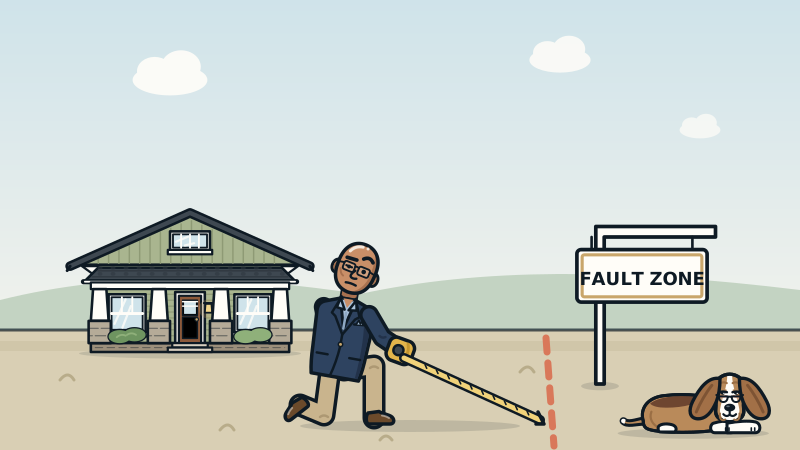
Not automatically. California's Alquist-Priolo Earthquake Fault Zoning Act and Seismic Hazards Mapping Act make sellers disclose mapped fault, liquefaction and landslide zones. Whether buyers pay less is a location question an appraiser measures with nearby sales. The building's own weak spots, like a soft story or an unbolted foundation, are judged separately.
California has two kinds of earthquake zone maps
Every house in California shakes now and then. The state maps just show where the ground has extra opinions.
The first set comes from the Alquist-Priolo Earthquake Fault Zoning Act (Public Resources Code section 2621 and after). It was written after the 1971 San Fernando earthquake to reduce damage from a fault breaking the ground surface. The California Geological Survey (CGS) says these zones can run for miles but average about a quarter mile wide. A building for people to live in cannot be placed over the fault, and it generally has to sit at least 50 feet away. CGS has published more than 500 of these maps, with zones in 37 counties and more than 100 cities.
One detail surprises people. The Act's rules for new projects leave out a single-family wood-frame or steel-frame home of up to two stories when it is not part of a development of four or more homes. Cities and counties can still require more.
The second set comes from the Seismic Hazards Mapping Act, passed in 1990 after the Loma Prieta earthquake. These maps show areas prone to liquefaction (loose, wet soil that turns soft in strong shaking) and earthquake landslides. Most new development there needs a site study by a licensed engineer or geologist first.
What a California seller has to disclose
Here is what shows up in the sale paperwork:
- Fault zone. Under Public Resources Code section 2621.9, the seller or the seller's agent must tell buyers when the property is in a mapped earthquake fault zone.
- Seismic hazard zone. The Natural Hazard Disclosure Statement asks whether the home sits in a Seismic Hazard Zone, and whether that means landslide, liquefaction or both.
- Older homes. Under Government Code section 8897.1, the seller of a light-frame home with one to four units built before January 1, 1960 must give the buyer the Homeowner's Guide to Earthquake Safety. The seller also discloses whether they know of certain listed weaknesses.
That older-home rule has exceptions. Court-ordered sales, foreclosures and transfers by a trustee or executor running an estate or trust are among them. If you are selling a parent's home through a trust, ask your attorney which forms still apply.
Want to check a parcel yourself? CGS runs a free map called EQ Zapp that shows fault zones and seismic hazard zones for any address in the state. It takes about as long as reading a listing headline.
Soft-story rules mostly hit apartments and condos
A soft story is a ground floor with big openings, like tuck-under parking, carrying living space above it. In a strong quake that floor can lean like a tired folding chair. Several California cities require owners to retrofit these buildings:
- Los Angeles: Ordinance 183893 (2015) covers wood-frame buildings with a permit applied for before January 1, 1978 and a ground floor of parking or similar open space. Buildings with three or fewer homes are not covered.
- San Francisco: The Mandatory Soft Story Retrofit Program, created in 2013, covers wood-frame buildings of three or more stories, or two over a basement or underfloor area, with five or more units and a building permit applied for before 1978.
- Oakland: Covers buildings designed or built before 1991 with five or more units and a weak lower story or crawl space.
- Berkeley: Covers wood-frame buildings of five or more units with a soft, weak or open ground floor.
Single-family homes are generally outside these programs. Condo owners are not. If a condo building still needs its retrofit, that bill lands on the association and often on owners. That can show up as a special assessment. For more on that side, see condo appraisals, HOA reserves and special assessments.
Retrofits and Brace + Bolt grants for houses
For houses, the common weak spot is older and lower. Many wood-frame homes built before 1980 sit on a raised foundation. Some have short cripple walls in the crawl space and are not bolted down. A retrofit bolts the house to its foundation and braces those walls.
The California Earthquake Authority (CEA) runs the Earthquake Brace + Bolt program. It offers grants of up to $3,000 toward a retrofit in eligible ZIP codes, and income-eligible households may get extra funds that can cover up to 100% of the cost. Homeowners do not need a CEA policy to apply. Registration opens in set windows, so check the program site for the next one. In 2025 the program opened to non-primary homes, such as rentals, for the first time. CEA also offers a premium discount of up to 25% for properly retrofitted qualifying homes.
Does a retrofit add value? It adds a fact. A buyer's inspector will find that bolted foundation or that missing one. What buyers pay for it is something I measure, not something I add at the invoice price. A $6,000 retrofit is not an automatic $6,000 on the grid.
How I measure a fault zone instead of fearing it
A mapped zone is part of location, so I treat it like any other location factor: with sales.
- Keep comps in the same situation. If the subject sits in a fault zone along the Hayward Fault in Berkeley, Oakland, Hayward or Fremont, the best comps sit in or right beside that same zone.
- Test the line. When a zone boundary runs through a neighborhood, similar homes just inside and just outside it are paired sales. If they keep selling at about the same price, the zone is not moving price there.
- Keep the building separate. An unbolted foundation or an old soft story is a fact about the building, not the location. It goes on the line that names it, so a reader is not left guessing which problem is being priced.
- Check the wider market. A rate found inside one tiny pocket has to hold up across a bigger set of sales before I trust it.
Hypothetical: say two similar 1950s homes in Alameda County sit four blocks apart, one inside a fault zone and one outside. If the sales history shows buyers treating them the same, the appraisal does not invent a discount. If buyers clearly pay less inside, the appraisal shows the sales that prove it. For more on how location lines work, read why a neighbor's sale takes no location adjustment.
What to do before you buy or sell
- Look up the address on EQ Zapp for fault and seismic hazard zones.
- Read the Natural Hazard Disclosure report as soon as it arrives, not on signing day.
- For a pre-1960 house, expect the Homeowner's Guide to Earthquake Safety in the disclosure packet.
- For a condo, ask the HOA whether the building is covered by a soft-story program and whether the work is done, paid for or still coming.
- For an older raised-foundation house, look under it, or have an inspector do it, for bolts and braced cripple walls.
- Keep retrofit paperwork: permit, final sign-off, engineer's letter and photos. Give a copy to the appraiser.
- Ask about earthquake insurance. The California Department of Insurance says a homeowners policy does not cover earthquake damage, but your insurer must offer to sell you earthquake coverage. A licensed agent can walk you through the options.
Fear sells headlines. Sales set value.
Key takeaways
- California maps two kinds of earthquake zones: fault rupture zones and liquefaction or landslide zones.
- Sellers must disclose mapped zones, and older 1 to 4 unit homes come with an earthquake safety guide.
- Soft-story retrofit programs in Los Angeles, San Francisco, Oakland and Berkeley mostly cover apartments and condos.
- Earthquake Brace + Bolt offers grants of up to $3,000 for qualifying older homes in eligible ZIP codes.
- A zone is a location question measured with sales; a building's weak spots go on their own line.
Getting this answered in California
Mapped fault zones and older soft-story buildings come up most in Bay Area cities along the Hayward and San Andreas faults and in Los Angeles, which requires retrofits of older wood-frame soft-story buildings. I am a California Certified Residential Appraiser (License AR041465) and appraise homes statewide, including Alameda County, San Francisco County, Los Angeles County, Contra Costa County, Santa Clara County. See every area I serve.
Get the best posts once a week.
Priced Right is one email a week with the most useful appraisal and pricing posts and what the market is doing. Never more than one a week. Unsubscribe anytime.
People also ask
Does living in an earthquake fault zone lower home value in California?
Not automatically. A mapped zone is a location factor, and an appraiser measures it by comparing similar sales inside and just outside the zone. In some areas buyers barely react, and in others they pay less.
How do I know if my California home is in an earthquake fault zone?
Use the California Geological Survey's free EQ Zapp map, which shows fault zones and seismic hazard zones for any address. The Natural Hazard Disclosure report in a sale also lists them.
Does a soft-story retrofit apply to single-family homes in California?
Generally no. The mandatory programs in Los Angeles, San Francisco, Oakland and Berkeley target multi-unit buildings, such as apartments and condos, with weak ground floors. Older houses on raised foundations have a different fix, bolting and bracing, which a grant program can help pay for.
Does earthquake retrofitting increase home value?
It can help buyers feel better and may lower earthquake insurance premiums, but it is not added at its cost. An appraiser looks at how local buyers actually price retrofitted homes compared with homes that still need the work.
Sources
- California Geological Survey: Alquist-Priolo Earthquake Fault Zones
- California Geological Survey: Seismic Hazard Zones (Seismic Hazards Mapping Act)
- California Government Code section 8897.1: Homeowner's Guide to Earthquake Safety
- San Francisco Department of Building Inspection: Mandatory Soft Story Program
- California Earthquake Authority: Brace and Bolt Grants
Got a question we haven't answered?
Suggest a topic or ask your own appraisal question. The best ones become posts.