Does the median sale price tell you what your California home is worth?
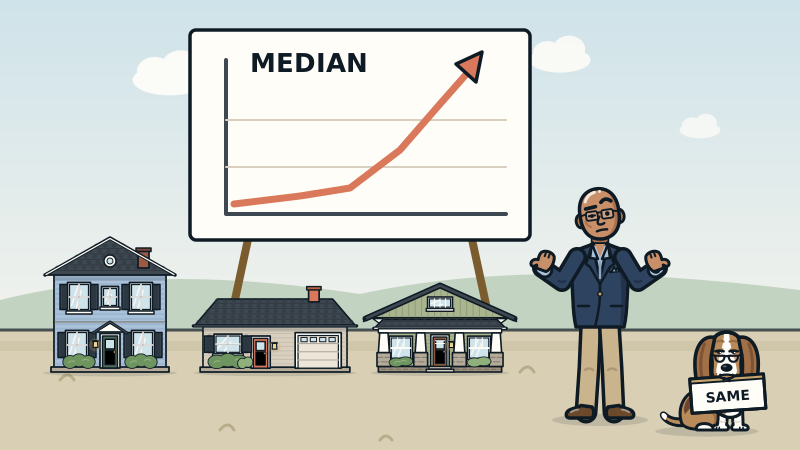
No. A median sale price is the middle of whatever homes happened to sell, so it moves when the mix changes. The California Association of Realtors notes that its medians can be influenced by the characteristics and size of homes sold. Your home's value comes from sales of homes like yours, adjusted for real differences.
A median is the middle of what sold, not the middle of what exists
The median is the price in the middle when you line up every sale from lowest to highest. The California Association of Realtors (C.A.R.) puts it simply in its monthly reports: half sold for more and half sold for less. It also notes that medians are more typical than averages, which a few very cheap or very expensive sales can skew.
That is why the median is the headline number. In its September 2026 report, released October 19, 2026, C.A.R. put the statewide median for existing single-family homes at $899,720. That was down 0.2% from August and up 1.7% from September 2025.
Here is the catch. The median describes the houses that sold that month. Your house did not sell that month. It sat there, minding its own business, while the headline gave it a new number. A median is a group photo. You are asking it for a passport photo.
How the median can rise while every house stays flat
This one is easiest to see with a hypothetical. Picture a small Inland Empire town with three kinds of single-family homes. Every price below is made up for the example, and every house holds its value perfectly steady all year.
| Month | Bungalows sold ($640,000 each) | Ranches sold ($850,000 each) | Two-stories sold ($1,100,000 each) | Median |
|---|---|---|---|---|
| March | 5 | 3 | 1 | $640,000 |
| July | 3 | 3 | 3 | $850,000 |
The headline writes itself: median price up 33% since spring. Not one house in town went up a dollar. All that changed was which houses sold. In March the small homes dominated the list. In July more big homes sold, and the middle of the line shifted.
Run it backward and the median drops sharply while every house stays flat. That is how a seller ends up panicking, or celebrating, over a market that never moved.
This is not a math trick I made up. C.A.R.'s own report notes say median prices can be influenced by changes in cost and by changes in the characteristics and size of homes sold. In the September 2026 release, C.A.R. said a bigger share of high-priced homes was affecting the statewide median. Million-dollar sales rose to 35.9% of sales from 35.2% in August.
Other ways a median can fool you
- Small samples. A city with eight sales in a month can swing hard on one estate sale or one remodeled showpiece. The fewer the sales, the louder each one gets.
- New construction. When a new subdivision starts closing homes, it can pull a city median up or down depending on its price point, even if existing homes did nothing.
- Neighborhood mix. A city median blends the hills, the flats, the condos near the freeway (if the report includes them) and the estates on the ridge. Your house lives in one of those places, not all of them.
- Lag. Closed sales were negotiated weeks before they closed. A median built from a long window can describe a market that already moved. I break that problem down in why a six-month average is already stale.
None of this makes the median useless. It tells you roughly where a big market sits and which way the crowd is drifting. It is a weather report for the county, not a thermometer in your living room.
Better ways to read what your home is worth
The Federal Housing Finance Agency (FHFA) explains why it does not build its house price index from medians. Its FAQ says comparing mean or median values can mislead because they reflect changes in both the price and the quantity of housing. In plain words, bigger or better homes in the mix look like rising prices. FHFA instead tracks repeat sales and refinances of the same properties, which it calls a constant quality approach.
| Measure | What it tells you | Where it can still fool you |
|---|---|---|
| Repeat sales index (FHFA, Case-Shiller) | Price change on the same homes over time | Covers whole metros and runs behind |
| Paired sales | What buyers paid for one difference, including time, in your segment | One pair is a story. You need several that agree. |
| Price per square foot in a tight group | A quick screen among truly similar homes | Mixes land, size and condition if the group is loose |
| Sale-to-list ratio and days on market | How hard buyers are pushing right now | Shows pressure, not a price level |
| Pending sales at a predicted close | The freshest read on deals made this month | Not closed yet, so it has to be estimated carefully |
The best answer uses several of these together, built from homes that compete with yours. For the index side, see how the Case-Shiller index works.
What I see in the field
The most common version of this mistake sounds like: the county median is up 5%, so my house is up 5%. Sometimes it is. Sometimes the county number rose because more big homes sold in the hills while your tract of three-bedroom ranches went sideways.
When I measure how the market moved for a house, I measure it inside that house's own segment. I test the shortest recent windows the sales can support, like 30 and 45 days, before I fall back on longer ones. I read pending sales at a predicted close: the list price times the sale-to-list ratio measured on recent similar sales. For loans sold to Fannie Mae, time adjustments have to be supported by evidence, and the Selling Guide names paired sales and home price indexes among the accepted support. A headline median that blends different kinds of homes is a weak stand-in for either one.
Online estimates have the same blind spot in a fancier outfit. They are not evidence. Sales are.
How to read a median headline without getting fooled
- Check what is in it. Single-family only, or condos too? City, county or statewide?
- Check the count. A median from 12 sales and a median from 1,200 sales are not the same kind of fact.
- Ask what sold. If more large or high-end homes closed this month, the median can rise with no change in value.
- Compare like with like. Pull recent sales of homes near yours with similar size, beds, baths, lot and condition.
- Look at the short windows. Compare the last 30, 45 and 90 days for homes like yours, with the sale count next to each.
- Watch pressure signals. Sale-to-list ratios and days on market for similar homes often show a turn before the median does. Here is how sale-to-list works.
- Get evidence when money is on the line. For a sale, an estate or a divorce, an appraisal built from adjusted comparable sales tells you what your house is worth, not what the crowd did.
Key takeaways
- A median is the middle of the homes that sold, so it moves when the mix of homes changes.
- C.A.R. itself says its medians can be influenced by the characteristics and size of homes sold.
- FHFA builds its index from repeat sales of the same homes to avoid the mix problem.
- Your home's value comes from adjusted sales of homes like yours, read in the most recent window the data supports.
Getting this answered in California
C.A.R.'s report notes say medians can be influenced by the characteristics and size of homes sold, which applies to every city and county median quoted in California. I am a California Certified Residential Appraiser (License AR041465) and appraise homes statewide, including Los Angeles County, Riverside County, San Bernardino County, Alameda County, Santa Clara County. See every area I serve.
Get the best posts once a week.
Priced Right is one email a week with the most useful appraisal and pricing posts and what the market is doing. Never more than one a week. Unsubscribe anytime.
People also ask
Why did the median home price go up when my home's value didn't?
A median moves when the mix of homes that sold changes. If more large or high-end homes sold this month, the median can rise even though no single home gained value. C.A.R.'s reports note that medians can be influenced by the characteristics and size of homes sold.
Is the median or the average home price more accurate in California?
C.A.R. says medians are more typical than averages because averages get skewed by a small share of very low or very high sales. Neither one is your home's value. Both describe the group of homes that sold, not any one house.
What is a better measure of home price change than the median?
Repeat sales indexes, like FHFA's House Price Index, track the same homes over time, which removes most of the mix problem. For a single house, paired sales and recent sales of similar homes in the same area give the most direct answer.
Can an appraiser use the county median to adjust for market changes?
For Fannie Mae loans, time adjustments must be supported by evidence, and the Selling Guide names paired sales and home price indexes among accepted support. A raw median from a headline mixes different homes, so it is a weak basis for adjusting one property.
Sources
Got a question we haven't answered?
Suggest a topic or ask your own appraisal question. The best ones become posts.