Do power lines, train tracks or cell towers hurt California home values?
Sometimes, but never by a set amount. Fannie Mae requires appraisers to report adverse site conditions and nearby land uses and explain their effect on value, and California sellers must disclose known nuisances. Whether a power line, rail line, cell tower or gas station lowers a price is measured with local sales, near versus away.
You can remodel a kitchen. You cannot remodel the neighbors.
Appraisers call these external factors. They are things off your lot that you can't fix, paint or move. A steel tower behind the back fence. A freight line two houses down. A gas station on the corner with lights that never sleep.
Fannie Mae's appraisal rules say the appraiser must comment if a site has adverse conditions or if there is market resistance to it. The appraiser also has to consider the present or anticipated use of any adjoining property that may affect it. So nobody gets to pretend the tower is not there.
The standard lender data rules even give these things names. On the long-running location field, an appraiser rates a sale as neutral, beneficial or adverse, and picks factors such as Industrial, Commercial, Busy Road, Public Transportation and Adjacent to Power Lines. Yes, power lines made the official list. That tells you how often this comes up.
What the list does not do is set a price. A label says what is next door. The sales say what it costs.
Not every neighbor is the same kind of problem
People lump all of these together. Buyers don't. Each one bothers a different sense, and some of them help.
| Neighbor | What buyers notice | What I check |
|---|---|---|
| Big transmission towers | The view, the hum, the easement in the yard | Does the line cross the lot or sit across the street? Can the yard be used? |
| Ordinary street poles | Usually not much | Whether sales on that street differ at all. Often they don't. |
| Freight or commuter rail | Horns, rumble, crossing gates | Distance to the tracks, a sound wall, how often trains run |
| A train station | Noise and parking, or a short commute | Some buyers pay more to walk to a train. Others pay less to hear one. |
| Cell tower | The look of it, sometimes worry | Is it on the lot, next door or down the block? |
| Gas station | Lights, traffic, smell, late hours | Does the house side or back to it? Is there a wall? |
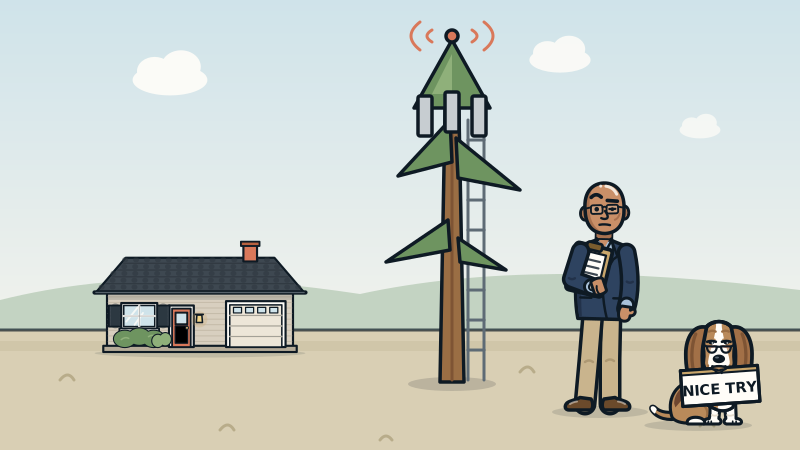
Some towers are dressed up as pine trees. I respect the effort. Nobody has ever been fooled by a 70-foot pine with no pinecones and a ladder.
I get asked about health concerns, too. I am an appraiser, not a scientist. My job is to measure how buyers actually reacted in the price, whatever their reasons.
How I measure it instead of guessing
The tool is paired sales: two similar homes that sold around the same time, where the main difference is the thing you are testing. One backs to the tracks. One sits three streets away. After adjusting for size, condition and anything else that differs, the gap left over is what buyers paid for the tracks.
Here is a hypothetical. These numbers are made up to show the method. Your street's number could be zero.
| Hypothetical pair, 1960s ranches in Hayward | Backs to power lines | Interior street | Gap (homes otherwise alike) |
|---|---|---|---|
| Pair A | $842,000 | $880,000 | 4.3% |
| Pair B | $815,000 | $851,000 | 4.2% |
| Pair C | $869,000 | $899,000 | 3.3% |
Three pairs that agree are a start, not the finish. Next I check the wider market: every sale that backs to that same line across the area, compared with similar homes away from it. If the side by side pairs and the wider set disagree, the one built on more sales wins.
A few rules keep this honest:
- Same street, no location adjustment. A comp that backs to the same line as your house shares your location. More on that in why the house next door never takes a location adjustment.
- Bracket it. I look for sales next to the line and sales away from it, so the adjustments don't all point one way.
- Zero has to be earned. If the sales show no difference, the adjustment is zero, and I show the test that proves it.
- Too small to measure means no adjustment. If the gap is smaller than what the sales can reliably detect, it doesn't go on the grid.
The same approach works for traffic. I wrote about that in the busy street post.
What California sellers have to disclose
California's Real Estate Transfer Disclosure Statement, set out in Civil Code section 1102.6, asks the seller about things like easements, environmental hazards such as fuel or chemical storage tanks, and "neighborhood noise problems or other nuisances." A train that shakes the dishes at 2 a.m. is the kind of thing a buyer would hope to read about there.
Civil Code section 1102.17 adds a written notice when the seller knows the home is next to, or zoned to allow, certain industrial uses, or is affected by a nuisance from one.
Agents have a duty here too. Under Civil Code section 2079.16, a seller's agent must disclose facts they know that materially affect the value or desirability of the property, when the parties don't already know them or can't easily see them.
If you are using an FHA loan, HUD's appraisal handbook has its own section on environmental and safety hazards, so ask your loan officer early if there is a tower or tank nearby.
Disclosure law has details that matter. If you are unsure what to disclose, ask a real estate attorney.
What I see in the field
The biggest mistake I see is the borrowed discount. Someone read that power lines cost 10% somewhere, and now every house within a mile gets 10% knocked off. That is not an appraisal. That is a rumor with a calculator.
The second mistake is the opposite: a comp across town on a quiet loop, no location adjustment at all, and a subject that backs to the rail yard. When the location line is blank and the locations clearly differ, the report should explain why.
Where I do find an effect, I look in two places. The price, of course. And the time it took to sell, because a smaller group of willing buyers can stretch days on market even when the final price holds up. Both are evidence. Both get measured.
And sometimes the answer is nothing. In a tight market with almost no inventory, buyers often shrug at a pole line and write the offer anyway. If the sales say zero, I say zero, and I show why.
What to do before you buy or list
- Visit at the worst time. Rush hour for the gas station. Evening for the trains. A windy day under the lines.
- Check the disclosures. Read the seller's Transfer Disclosure Statement and the title report for easements.
- Ask for the right comps. Recent sales on the same line or the same tracks, plus similar homes away from them.
- Compare days on market for the near homes and the away homes, not only price.
- Price it in both ways. A discount you get as a buyer is one the next buyer will expect too.
- Don't borrow a number. A percentage from a study in another state is not your street.
- Get evidence if it matters. If you are pricing a listing next to a tower, a pre-listing appraisal can measure the effect before buyers argue about it.
Key takeaways
- Power lines, rail, cell towers and gas stations are external factors an appraiser must address.
- There is no standard discount. Local paired sales, checked against the wider market, set the number.
- A comp on your same street or same line takes no location adjustment.
- California sellers must disclose known nuisances, easements and certain industrial uses nearby.
- Sometimes the measured answer is zero, and that has to be proven too.
Getting this answered in California
Commuter rail runs through established neighborhoods along the Caltrain corridor in San Mateo and Santa Clara counties, through East Bay cities in Alameda County, and along the Metrolink system in Southern California. I am a California Certified Residential Appraiser (License AR041465) and appraise homes statewide, including San Mateo County, Santa Clara County, Alameda County, Los Angeles County, Orange County. See every area I serve.
Get the best posts once a week.
Priced Right is one email a week with the most useful appraisal and pricing posts and what the market is doing. Never more than one a week. Unsubscribe anytime.
People also ask
Do power lines lower home value in California?
They can, but there is no set percentage. An appraiser compares similar sales that back to the same line with sales away from it. In some neighborhoods the gap is clear, and in others buyers barely react.
Does living near train tracks hurt resale value?
It depends on the trains and the buyers. Freight horns at night can cost something, while a short walk to a commuter station can attract buyers. Local sales near and away from the tracks show which effect wins.
Do I have to disclose a cell tower or power lines when I sell in California?
California's Transfer Disclosure Statement asks about easements and neighborhood nuisances, and a seller's agent must disclose known facts that materially affect value or desirability. Ask a real estate attorney if you are unsure what applies to your property.
Can I get an FHA loan near power lines or a gas station?
Often, but FHA has its own environmental and safety hazard rules that the appraiser checks. Ask your loan officer before you write the offer so there are no surprises in escrow.
Sources
- Fannie Mae Selling Guide B4-1.3-04: Site Section of the Appraisal Report
- Freddie Mac: Uniform Appraisal Dataset (UAD) Requirements, location rating and factors
- California Civil Code section 1102.6: Real Estate Transfer Disclosure Statement (text reproduced)
- California Civil Code section 1102.17: Industrial use notice
- California Civil Code section 2079.16: Agency disclosure duties
Got a question we haven't answered?
Suggest a topic or ask your own appraisal question. The best ones become posts.