Should you underprice a California home to start a bidding war?
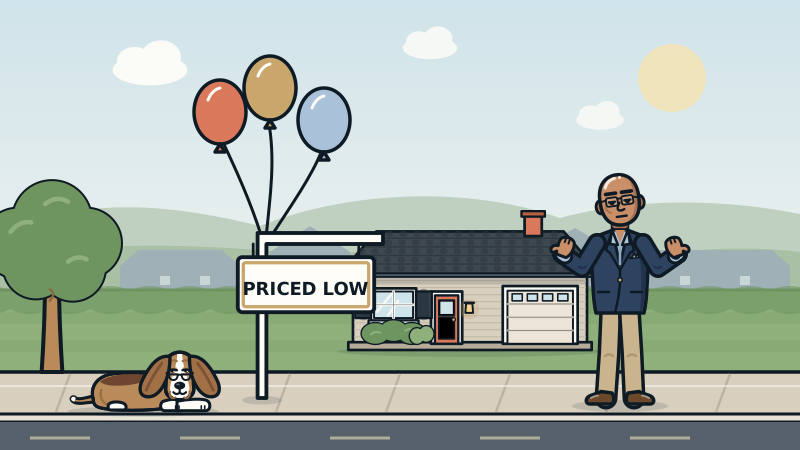
Only when the data shows deep demand. Underpricing works where similar California homes are selling fast and above list right now, as Redfin has reported for the Bay Area. In a slower segment it can just sell low. And under Fannie Mae rules, the lender uses the lower of price or appraised value, so a runaway price may not appraise.
Underpricing is a party invitation. It only works if people show up.
Underpricing means listing below where the evidence says the house will sell, on purpose. The goal is more showings, more offers and buyers bidding against each other until the price climbs past where it would have started.
In parts of California, this is close to standard practice. In an April 2026 report on February sales, Redfin said Bay Area home sellers are known for underpricing their homes to fuel bidding wars. Redfin found that only 7.4% of February home sales in San Francisco included price cuts, the lowest share among the metros in the report. San Jose (11.1%) and Oakland (14.3%) were also near the bottom. Nationally, the same report said a record 34% of February sellers cut their list price.
That gap tells the story. Where buyers are lined up, a low price is bait. Where they are not, a low price is just a low price.
A list price is a marketing decision. Value is what the market proves. Those are two different numbers, and the trouble starts when people forget which one they are looking at.
How to tell which market you are in
Don't decide from a feeling, a neighbor's story or a headline. Measure it, and measure it now. A 12-month average can tell you the market is hot long after it cooled. I start with the shortest window the data supports, often the last 30 or 45 days, and only widen it when there are too few sales.
| Signal, similar homes nearby | Underpricing likely works | Underpricing likely backfires |
|---|---|---|
| Sale-to-list ratio, last 30 to 45 days | Well above 100% | At or below 100% |
| Days on market | Short and getting shorter | Stretching out |
| Price cuts on competing listings | Rare | Common |
| Pending sales at predicted close | Above recent closed sales | Flat or below |
| Your house versus the competition | Best condition on the street | Needs work or has a busy road |
For pendings, I estimate a predicted close: the asking price times the sale-to-list ratio measured on recent similar sales, with a lower measured ratio for listings that sat past about 40 days. It is the closest thing to a live read the data offers.
Read sale-to-list with care. In a neighborhood where everyone underprices, a 110% ratio may say more about the list prices than about rising values. I explain that trap in the sale-to-list post.
A hypothetical: one house, two markets
Say a 1950s three-bedroom ranch in Fremont. The best adjusted sales point to a range of about $1,380,000 to $1,440,000. Every number here is made up to show the idea.
Hot market version. Similar homes closed at about 109% of list over the last 30 days, in about nine days on market. The seller lists at $1,299,000. Forty groups tour the first weekend. Eight offers come in. The winner is $1,520,000 with an appraisal gap clause. The underprice did its job: it pulled a crowd that bid past the range.
Cool market version. Same house, but similar homes closed at about 98% of list over the last 45 days, and days on market are climbing. The seller lists at $1,299,000 anyway. Two offers come in near $1,330,000. Now the seller is stuck choosing between taking less than the evidence supported, countering and hoping, or pulling the listing and relisting higher. That last move looks to buyers like a seller who doesn't know what the house is worth.
Same house. Same price. Opposite results. The difference was the market, and the market was measurable before the sign went up.
What happens at the appraisal when the price jumps
Back to the hot version. The contract is $1,520,000. The buyer's lender orders an appraisal, and the appraiser has to deal with the whole story.
Fannie Mae requires the appraiser to report whether the home was listed in the 12 months before the effective date, with each offering price, date and the days on market, and to analyze the contract. So the $1,299,000 list price and the eight-offer weekend are both in front of me.
Neither one sets the value. The low list price was a strategy, not evidence that the house is worth less. The high contract is one buyer's number, not proof the market moved. What I can use is closed sales, pendings read at predicted close, and a time adjustment if the trend supports one. Fannie Mae says time adjustments, or the lack of them, must be supported by evidence.
Say the evidence supports $1,440,000. Fannie Mae has the lender use the lower of the sales price or the appraised value. The price gap is $80,000. If the buyer planned on 20% down, the loan drops from $1,216,000 to $1,152,000, and the buyer needs $64,000 more cash to close.
That is why a bidding war needs a gap plan. For the buyer's side, read will the house appraise if we offered way over asking.
What I see in the field
The most common mix-up: the seller underprices to start a war, wins it, and then expects the appraisal to bless the top bid. The appraisal doesn't care how exciting the weekend was. It cares what similar homes closed for, adjusted to this house and to today.
The second one: buyers who think the list price is the value. An underpriced list is an opening line. Bidding to the top of a well-measured range is not overpaying. Bidding past it might be.
When a bidding war is real and widespread, it does show up in my work. Pendings start reading above the last closed sales. The short-window trend climbs. When the next sales close at the new level, the next appraisal gets to use them. That is how a new price is earned: one recorded sale at a time.
A bidding war tells me demand is strong. It doesn't tell me the last $40,000 was paid by the market and not by one buyer who fell for the backyard lemon tree.
Before you price low on purpose
One rule first. Under California Civil Code section 2079.16, a seller's agent owes the buyer, as well as the seller, a duty of honest and fair dealing and good faith. Pricing low is a strategy. Telling buyers something untrue about it is not. If you are unsure where that line sits, ask a real estate attorney.
- Measure the last 30 to 45 days of sale-to-list and days on market for truly similar homes.
- Count the competition. Underpricing next to three better listings just makes you the cheapest house on a slow street.
- Know the evidence range before you pick a number. A pre-listing appraisal gives you one in writing.
- Set the offer plan up front: an offer date, how you will handle counters, and the lowest price you would accept.
- Ask for gap terms. An offer with an appraisal gap clause and proof of cash is worth more than a bigger number with none.
- Have a plan B if only one or two offers arrive. Decide it now, while you are calm.
Key takeaways
- Underpricing works only where demand is deep, and that can be measured before you list.
- Use the last 30 to 45 days of sale-to-list, days on market and pendings, not a 12-month average.
- The list price is a strategy and the contract price is one buyer. Neither sets appraised value.
- Lenders use the lower of price or appraised value, so a bidding war needs a gap plan.
- A seller's agent in California owes buyers honest and fair dealing, even when pricing low.
Getting this answered in California
Redfin reported that San Francisco, San Jose and Oakland had some of the lowest shares of February 2026 home sales with price cuts, and said Bay Area sellers are known for underpricing to fuel bidding wars. I am a California Certified Residential Appraiser (License AR041465) and appraise homes statewide, including San Francisco County, Santa Clara County, Alameda County. See every area I serve.
Get the best posts once a week.
Priced Right is one email a week with the most useful appraisal and pricing posts and what the market is doing. Never more than one a week. Unsubscribe anytime.
People also ask
Is underpricing a house a good strategy in California?
It can be in segments where similar homes are selling quickly and above list right now. In slower segments, it can lead to few offers and a low sale price. Check recent sale-to-list ratios and days on market before deciding.
Will the house appraise if it sells way over the list price?
Only if recent sales, adjusted to the house and to today, support the price. The list price and the number of offers do not set the value, and the lender uses the lower of the price or the appraised value.
Does underpricing my house lower the appraisal?
No. The appraiser reports the listing history, but a low list price is a marketing choice, not evidence of low value. The value comes from closed sales and pending sales, adjusted to the house and to the effective date.
How much below value should you list to start a bidding war?
There is no safe standard percentage. The answer depends on how deep buyer demand is in your price range this month, which you can measure with recent sale-to-list ratios, days on market and pending sales.
Sources
- Redfin via Business Wire: A Record 34% of February Home Sellers Cut Their List Price (April 2026)
- Fannie Mae Selling Guide B2-1.2-01: Loan-to-Value (LTV) Ratios
- Fannie Mae Selling Guide B4-1.3-02: Subject and Contract Sections of the Appraisal Report
- Fannie Mae Selling Guide B4-1.3-09: Adjustments to Comparable Sales
- California Civil Code section 2079.16: Agency disclosure duties
Got a question we haven't answered?
Suggest a topic or ask your own appraisal question. The best ones become posts.