What is the Uniform Property Data Report (UPDR), and is it an appraisal?
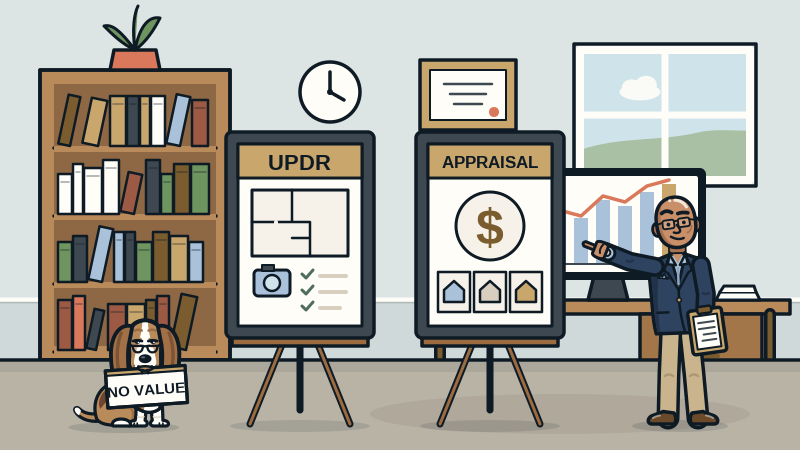
No. The Uniform Property Data Report (UPDR) is Fannie Mae and Freddie Mac's standard layout for property data reports, built on the Uniform Property Dataset. It records a home's observed features, photos and floor plan, with no opinion of value. Its use is mandatory for loans with application received dates on or after June 30, 2026.
The UPDR is a report layout, not a new kind of valuation
Fannie Mae and Freddie Mac introduced the Uniform Property Data Report in a joint announcement on July 30, 2025. They call it a "dynamic, standardized report template." In plain words, it is one shared layout for the report a property data collector turns in.
Here is why it exists. Before the UPDR, the data underneath was already standard, but every vendor could print it its own way. An underwriter juggling three vendors got three different reports about the same kind of house. Freddie Mac says the shared layout is meant to streamline reviews, simplify training and enable automated data validation. For anyone who has hunted for the bathroom count on page nine of a report that put it on page two last week, this is good news.
The dates that matter:
- Until June 30, 2026: use of the UPDR was voluntary.
- Application received on or after June 30, 2026: in the GSEs' words, "use of the UPDR will be mandatory."
- October 14, 2026: Freddie Mac's Uniform Property Dataset page lists a follow-up joint announcement, "Transitioning to UPDR Supports Greater Consistency in Underwriting." Read it on that page with your vendor.
The GSEs also say they designed the UPDR "to mirror the look and feel of the new Uniform Residential Appraisal Report (URAR)." The data report and the appraisal report finally dress alike. They just do very different jobs.
What goes into it: the Uniform Property Dataset
The UPDR is the printed face of the Uniform Property Dataset (UPD). The UPD is the list of data fields Fannie Mae and Freddie Mac built together for property data collection. It replaced each company's own dataset, and Freddie Mac says both GSEs have required it for property data reports since April 1, 2024.
Per both GSEs, the UPD supports a full interior and exterior collection, including images and a floor plan. Freddie Mac describes the work as "viewing and reporting property characteristics in a fact-based manner." Think room counts, measurements, features, photos and observed condition.
Who collects it? Freddie Mac says collectors must complete required training and undergo periodic criminal background checks, and that licensed or certified appraisers and trainees can also serve as collectors. Fannie Mae's Selling Guide (B4-1.4-11) requires a "trained and vetted property data collector," an annual background check, and a lender review of the collector's credentials every year.
One more point for your files. The UPD is separate from the Uniform Appraisal Dataset that sits behind the new URAR and UAD 3.6, though Fannie Mae says some fields are aligned. Two datasets, one family resemblance.
Is a UPDR an appraisal? No, and here is the difference
Both GSEs say it plainly. Fannie Mae: property data collection "is not an appraisal in that it does not involve the development of an opinion of value." Freddie Mac: "It's not an appraisal or appraisal report." The collector is the person who counts the bathrooms and leaves the math to someone else.
| Property data report (UPDR) | Appraisal | |
|---|---|---|
| Who does it | Trained, vetted data collector (can be an appraiser) | Licensed or certified appraiser |
| Licensing | Training and background checks per GSE rules | State appraiser license or certification |
| Opinion of value | No | Yes |
| Comparable sales | No | Yes, selected and adjusted |
| Standard it follows | The GSEs' Uniform Property Dataset | USPAP, plus lender and GSE rules |
| Main use | Supports value acceptance + property data (Fannie Mae), ACE+ PDR (Freddie Mac), and in some cases a hybrid appraisal | Supports a value for any loan, plus estates, divorce, planning and disputes |
So where does the value come from on a property data loan? On Fannie Mae's value acceptance + property data, Fannie Mae "accepts the value estimate submitted by the lender." On Freddie Mac's ACE+ PDR, the loan's eligibility comes from automated collateral evaluation in Loan Product Advisor. The report describes the house. The system makes the call on value.
What I see in the field: describing a house is not valuing it
I like good data. A clean floor plan and a full set of photos make everyone's job easier, including mine. Data collectors do real work, and a standard layout makes that work easier to check.
But a data collector describes what is there. An appraiser decides what it is worth and why. Those are two different skills. A collector can tell you the kitchen has quartz counters and the back bedroom has no closet. Neither fact tells you what buyers in that neighborhood paid for it. That answer comes from comparable sales, measured adjustments and judgment across the range of adjusted sales.
Here is when I would want a full appraisal anyway, even when the loan qualifies without one:
- Unusual property. A big view, a hillside lot, an ADU, a layout nobody else on the street has.
- Condition questions. A partial remodel, deferred repairs, or updates that never made it into public records.
- Unpermitted work. A garage conversion or an addition where the records and the house disagree.
- A value someone will challenge. An estate split, a divorce buyout, or any number a third party will pick apart later.
A quick note on terms. In lending, a hybrid appraisal usually means a collector visits and an appraiser finishes from a desk. At ValuedAudit, my private desktop and hybrid appraisal are the same product with no site visit: the client shares what they know, photos if they have them, and the pros and cons, and I build the value from records and market data.
A checklist for loan officers and processors
- Confirm your vendor delivers the UPDR. Ask each property data collection vendor, in writing, that its reports follow the current UPDR layout for files with application dates on or after June 30, 2026.
- Know what the file is getting. A full appraisal, an appraisal waiver (value acceptance), or value acceptance + property data on Fannie Mae, or ACE+ PDR on Freddie Mac. Fannie Mae allows its property data option only when the final DU submission shows that eligibility. Freddie Mac says to check the LPA Feedback Certificate before ordering.
- Review the report like an appraisal. Freddie Mac says PDRs "must be reviewed and underwritten, just like appraisal reports" and belong in quality control sampling. A matching layout makes that easier, not optional.
- Know where it lands. On Fannie Mae loans the collection goes to Fannie Mae's Property Data API. On Freddie Mac loans it goes through the Beyond ACE (bACE) API, which returns a 36-character property data ID. Keep that ID with the file.
- Prep the borrower for the visit. The collector needs every room, the garage, outbuildings and any ADU, with pets put away and a dated list of updates ready.
- Have an honest answer ready. When a borrower asks, "Did someone appraise my house?" the true answer is: "No. A trained collector recorded facts about your house, and the value was accepted through Fannie Mae's or Freddie Mac's process." If they want their own opinion of value for planning, that is a separate appraisal.
For more plain-language guides on the new forms, my free guides are at the free guides page.
Where the UPDR fits with value acceptance and UAD 3.6
The UPDR does not decide which loans skip an appraisal. Fannie Mae's DU and Freddie Mac's LPA still do that, under each GSE's existing program rules. The UPDR only sets how the property data report looks once a loan is on that path. For the program side, see my posts on value acceptance + property data and property data reports.
It also is not the UAD 3.6 appraisal change. UAD 3.6 and the new URAR govern appraisal reports. The UPDR governs data collection reports. They look alike on purpose, so an underwriter can move between them without a map. If you are tracking both at once, my post on what UAD 3.6 changes for loan officers covers the appraisal side.
The short version for your team: same house facts, same look, different jobs. The data report tells you what is there. The appraisal tells you what it is worth and shows the evidence. Facts over feelings, now in matching fonts.
Key takeaways
- The UPDR is Fannie Mae and Freddie Mac's standard layout for property data reports.
- It is mandatory for loans with application received dates on or after June 30, 2026.
- A UPDR records observed facts, photos and a floor plan. It contains no opinion of value and is not an appraisal.
- Eligibility for a property data option still comes from DU or LPA, not from the report.
- Unusual homes, condition questions and values that will be challenged still call for a full appraisal.
Getting this answered in California
The UPDR is a national Fannie Mae and Freddie Mac format, so a property data report on a loan in Alameda County follows the same layout as one in Los Angeles County. I am a California Certified Residential Appraiser (License AR041465) and appraise homes statewide, including Alameda County, Contra Costa County, Santa Clara County, Sacramento County, Los Angeles County. See every area I serve.
Get the best posts once a week.
Priced Right is one email a week with the most useful appraisal and pricing posts and what the market is doing. Never more than one a week. Unsubscribe anytime.
People also ask
Is the Uniform Property Data Report an appraisal?
No. Fannie Mae says property data collection is not an appraisal because it does not involve developing an opinion of value. The UPDR is the standard layout for that data, so it describes the house without valuing it.
When did the UPDR become required?
Fannie Mae and Freddie Mac made the UPDR mandatory for mortgages with application received dates on or after June 30, 2026. Before that date its use was voluntary.
Who fills out a Uniform Property Data Report?
A trained, vetted property data collector who visits the home and records its features, photos and a floor plan. Freddie Mac says licensed or certified appraisers and appraiser trainees can also serve as collectors.
Does the UPDR mean my loan does not need an appraisal?
Not by itself. Whether a loan can use property data instead of an appraisal is decided by Fannie Mae's Desktop Underwriter or Freddie Mac's Loan Product Advisor under each program's rules. The UPDR only standardizes the report once a loan is on that path.
Sources
- Fannie Mae and Freddie Mac joint announcement: Introducing the Uniform Property Data Report (July 30, 2025)
- Freddie Mac: Uniform Property Dataset and Uniform Property Data Report
- Fannie Mae: Uniform Property Dataset
- Fannie Mae Selling Guide B4-1.4-11: Value Acceptance + Property Data
- Freddie Mac: Property Data Collection, An Overview (Jan. 16, 2026)
Got a question we haven't answered?
Suggest a topic or ask your own appraisal question. The best ones become posts.